
By McKenli Williams / Nevada Policy
With 85% of land in Nevada controlled by the federal government, the Silver State has little room to build and grow.
In Southern Nevada, limited land and a growing population are straining the state’s economic growth. Auction records from the Bureau of Land Management (BLM) show an increasingly expensive market for federally released land in the Las Vegas Valley, and extreme variance in how much land is auctioned each year. So, what does the federal government’s monopoly of land actually cost Nevada?
The Southern Nevada Public Land Management Act (SNPLMA) provides a great case study. SNPLMA allows the BLM to sell designated federal lands within a boundary line in Clark County. 85% of the proceeds of each sale are redirected to conservation, allowing the federal government to purchase existing private parcels in exchange for its sale of government parcels. Consequently, Washington now owns more land than it did before SNPLMA was passed. Through SNPLMA 36,540 acres have been sold, while Washington has acquired 70,455 acres of existing private land.
This feedback loop creates a reality where the state’s largest landlord sets all the prices of land, and in doing so, determines the prices of development, housing, and doing business.
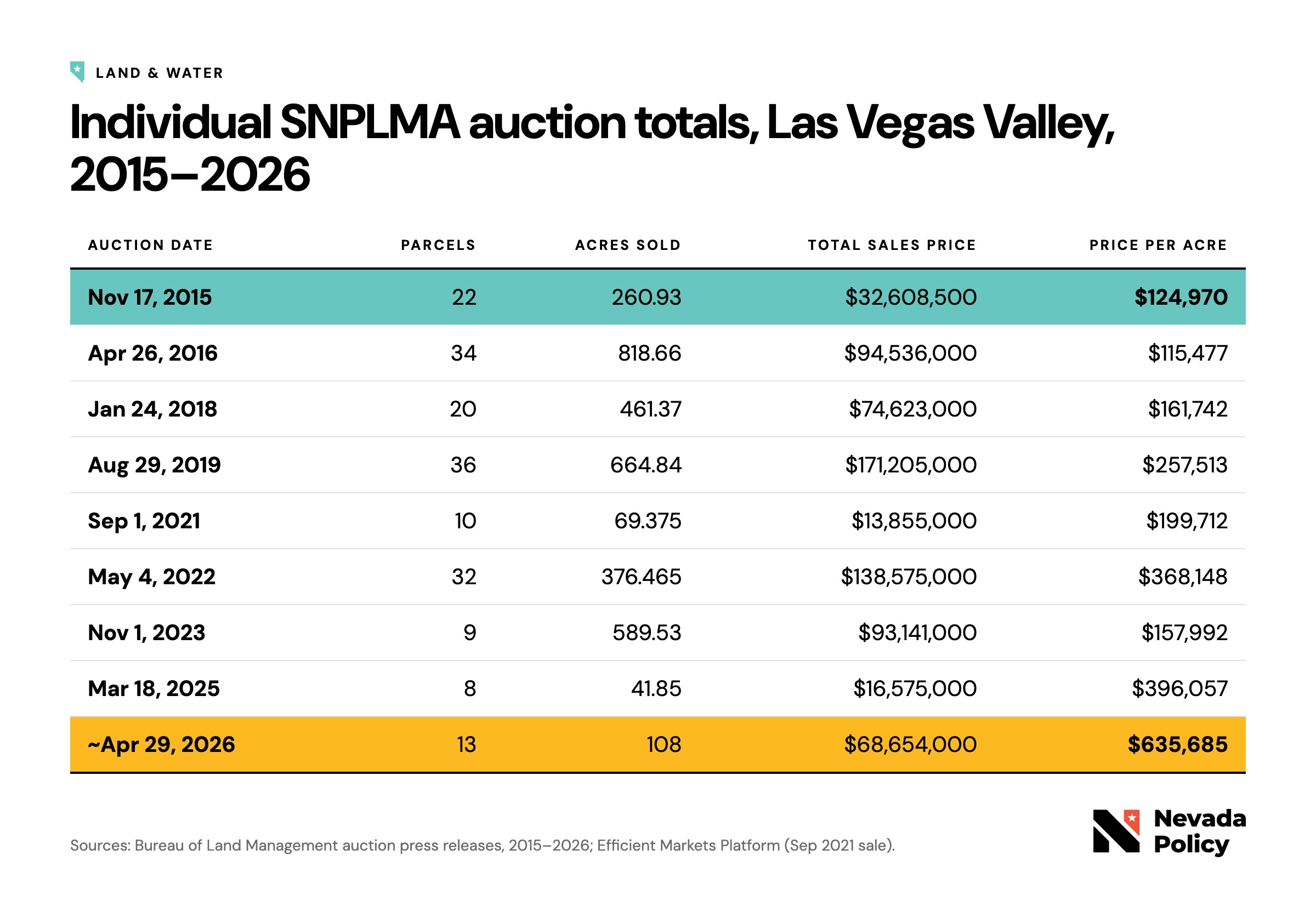
The historical land sale data of SNPLMA parcels illustrates this in numbers. In 2003-2004, the BLM sold more than 5,400 acres. By 2009-2010, that fell to just 40 acres, and in 2011-2012 a mere 5 acres were auctioned off. The number has yet to climb back to the average of the early 2000s, and only 589 acres were sold in fiscal year 2023-2024. Unsurprisingly, the price per acre has also fluctuated wildly. For instance, in 2002 the price per acre of auctioned land by SNPLMA was $50,226. By 2008 it increased tenfold, reaching $569,409.
Source: Bureau of Land Management, “SNPLMA Quick Facts and Program Statistics,” https://www.blm.gov/sites/default/files/documents/files/SNPLMA_3%20PROGRAM%20STATISTICS.pdf.
These fluctuations matter because land is a finite resource. Builders need it for housing, businesses need it for expansion, and communities need it for infrastructure like roads, schools, and power generation. Unlike other building necessities, land can’t be manufactured or shipped in from another state. When the government holds a monopoly on the surrounding land, supply depends on federal agencies’ discretion, not buyers and sellers. When only 5 acres are sold in a year, everything downstream is constrained.
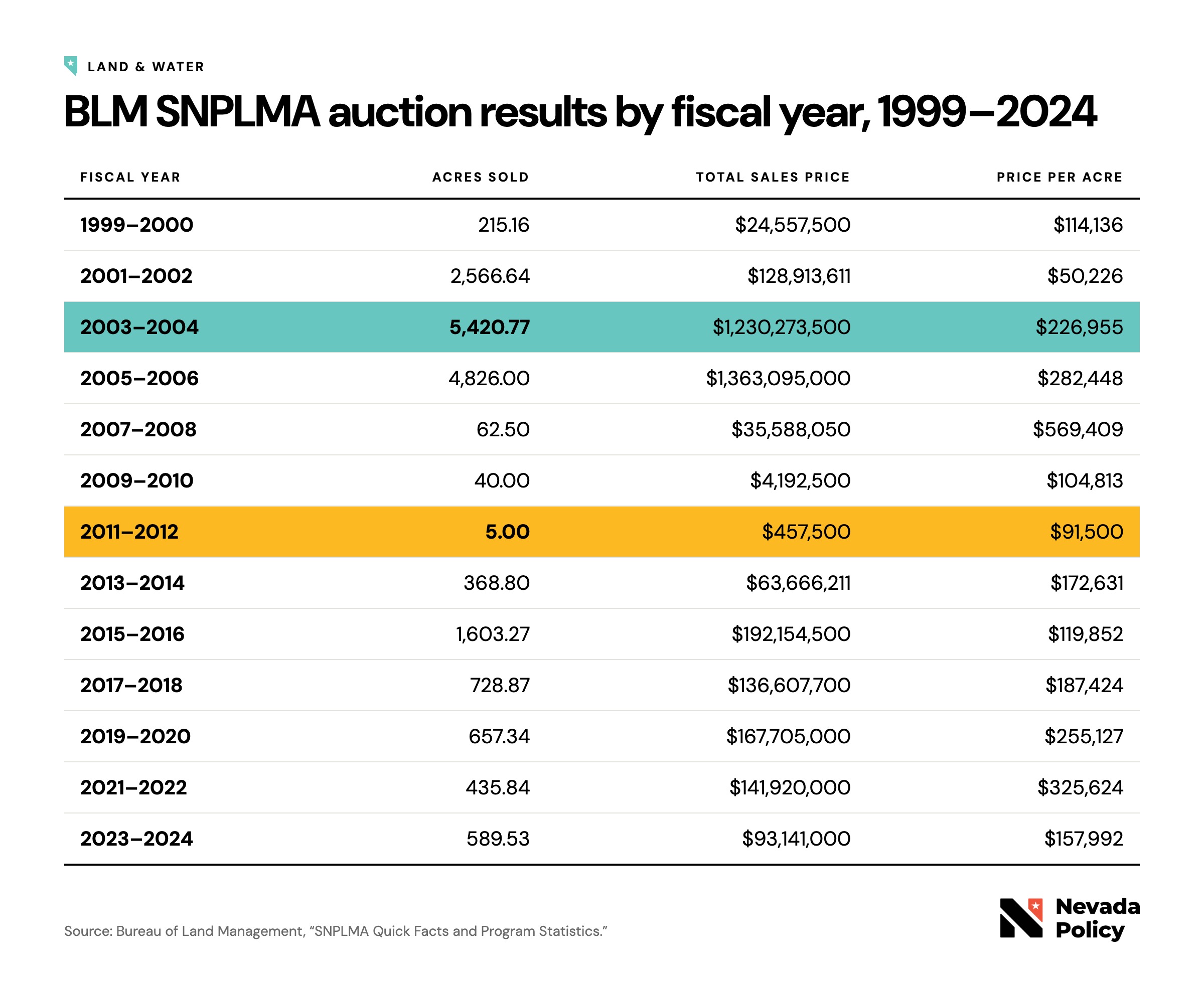
The auction records of individual sales also reveal a telling story. The table gives a close look at auctions in the Las Vegas Valley since 2015, revealing a clear pattern: as the acreage offered for sale has fallen and Clark County’s population has grown, the price per acre has risen from roughly $125,000 to over $635,000. That means that there was an increase of more than 400% between November 2015 and April 2026.
The table also illustrates that fewer parcels are being sold at each auction, and they cover smaller tracts, so the lots that reach the market are smaller. The average has shrunk from 24 acres per parcel in 2016 to about 5 acres in March of 2025, and 8 acres in 2026. Smaller lots limit what can be built on them. A 5-acre site can fit a modest apartment complex, but it can’t support the large communities that 60-acre parcels once allowed. With less land available and the pieces getting smaller, builders have fewer options, competition for each lot intensifies, and prices per acre rise.
Sources: Bureau of Land Management, “Land Sale Generates More Than $32.6 Million for Projects,” https://www.blm.gov/press-release/land-sale-generates-more-326-million-projects, Bureau of Land Management, “Land Sale Generates More Than $94.5 Million for Projects,” https://www.blm.gov/press-release/land-sale-generates-more-945-million-projects,Bureau of Land Management, “Land Sale Generates Almost $75 Million for Projects,” https://www.blm.gov/press-release/land-sale-generates-almost-75-million-projects, Bureau of Land Management, “In Compliance with SNPLMA, Land Sale Generates More Than $171.2 Million for Projects,” https://www.blm.gov/press-release/compliance-snplma-land-sale-generates-more-1712-million-projects, Efficient Markets, “Efficient Markets Platform,” https://app.efficientmarkets.com/salegroup/5401, Bureau of Land Management, “In Compliance with the SNPLMA, Land Sale Generates More Than $138.5 Million for Projects,” https://www.blm.gov/press-release/compliance-snplma-land-sale-generates-more-1385-million-projects, Bureau of Land Management, “Land Sale Generates More Than $93 Million for Projects,” https://www.blm.gov/press-release/land-sale-generates-more-93-million-projects, Bureau of Land Management, “Las Vegas Public Land Sale Nets More Than $16.5 Million for State Projects,” https://www.blm.gov/press-release/las-vegas-public-land-sale-nets-more-165-million-state-projects, Bureau of Land Management, “BLM Public Land Sale in Las Vegas Valley Nets Over $68 Million,” https://www.blm.gov/press-release/blm-public-land-sale-las-vegas-valley-nets-over-68-million.
Rising auction prices alone do not prove that federal ownership caused land appreciation. Land prices within private markets are influenced by many factors. But the federal government controls 88% of the land around Las Vegas with the authority to determine which parcels can be sold to private ownership, greatly affecting the market.
Clark County has about 70,000 acres of potentially developable land. But when factors such as terrain, infrastructure, road access, and utility availability are considered, the amount of developable land falls to just 23,000 acres.The county has used about 2,500 acres of land annually between 2017 and 2024. At that rate, the supply will most likely be gone within a decade.
When available land becomes increasingly expensive, it has a ripple effect. Homebuilders must pay more for property, increasing the costs associated with new construction. Commercial developers face higher barriers to entry. Businesses looking to invest in the state have fewer potential locations. These pressures can also influence what gets built. When land represents a larger share of costs, builders have stronger financial incentives to pursue projects that bring in more money.
Fixing this constraint doesn’t require developing every acre, giving up natural preservation, or abandoning responsible land management. It requires reconsidering a system where Washington arbitrarily controls the vast majority of Nevada’s land and has sole determination over when property becomes available. Transferring unappropriated BLM land would expand developable land, especially in rapidly growing Clark County.
A few auctions every year can’t substitute for a real private land market. Nevada’s economy can’t grow without the room to do it. So long as Washington controls roughly 85% of the state’s land, Nevadans will continue to face escalating costs.
Source: Nevada Policy, November 20, 2026. Reported by McKenli Williams.